
Customer Retention: Strategies That Work for Service Businesses
Search for customer retention advice and you will mostly find software advice. Onboarding sequences, health scores, NPS surveys, product-led growth loops. All reasonable if you sell a subscription with a cancel button.
None of it describes what happens when a client walks out of one of your locations on a Tuesday, fully intending to rebook, and then simply does not.
Multi-location service businesses have a different customer retention problem, and it needs a different playbook. This page is that playbook: what retention actually is (and how it differs from reactivation), why it is the highest-leverage number on a service P&L, how to measure it, and twelve concrete strategies organized by where the client sits in the lifecycle — from the first visit to the lapsed list.
What Customer Retention Is — and What It Is Not
Customer retention is the share of existing clients who keep doing business with you over a defined period. In a service business, “keep doing business” means one thing: they book again. Not that they follow your locations on Instagram, not that they open the newsletter. They occupy a booked-revenue slot on the schedule at the frequency your service line implies.
It helps to separate three terms operators tend to blur:
- Retention is keeping active clients active. It is proactive, and most of it happens inside the four walls: at checkout, in the chair, in the first ninety days.
- Churn is the inverse — the share of clients who stop coming back. We cover the definitions and math in what customer churn is and how to calculate it.
- Reactivation is recovering clients who have already lapsed. It is a different motion with different economics, and it deserves its own system — our customer reactivation guide covers it end to end.
The distinction matters because the interventions are different. Retention work is front-desk discipline, scheduling design, and staff-transition management. Reactivation work is list management and outreach. Operators who run one program and call it “retention” usually end up doing neither well.
One more structural point, because it breaks every SaaS playbook you will read elsewhere: service-business churn has no cancellation event. Your clients do not churn on a date. They fade. A member skips two weeks, a patient ignores a recall, a regular tries the salon closer to her new office. Which means customer retention in a service business is a detection problem before it is ever a strategy problem — and everything below is built around that fact.
Why Customer Retention Matters More in Multi-Location Businesses
Three reasons retention deserves a named owner and a line on the monthly reporting pack.
The economics are lopsided. The most-cited figure in the retention literature comes from Bain & Company: increasing customer retention rates by 5% increases profits by 25% to 95%. Bain’s research was cross-industry, but the mechanism is at its strongest in appointment-based businesses, where a retained client costs almost nothing to serve with marketing and shows up at full price. Meanwhile the replacement client arrives through paid acquisition, often on an intro discount, and has to survive the first-visit drop-off before contributing anything. We have run the reactivation vs. new-acquisition math in detail; the short version is that recovering an existing relationship is consistently the cheaper unit of revenue.
Churn compounds across locations. A single studio losing 40 clients a month is a problem. Twelve locations each losing 40 clients a month is 480 relationships — and the associated lifetime value — walking out the door every month, invisible on a corporate dashboard that reports aggregate revenue. Growth in new-client acquisition can mask that leak for years. Our customer churn statistics page collects the benchmark data; if you want to see what your own lapsed list is worth in dollars, the ROI calculator does that math against your ATV and list size.
The relationship belongs to a person, not a product. Clients are loyal to their stylist, their hygienist, their trainer. When that person leaves — and in multi-location service businesses, people leave — the client is at risk no matter how strong the brand is. Retention strategy has to account for staff turnover explicitly, because it is one of the largest single causes of client loss and the one operators plan for least.
How to Measure Customer Retention Rate
Before any strategy, a definition and a measurement. The customer retention rate formula:
Customer retention rate = ((E - N) / S) × 100E is the number of active clients at the end of the period. N is the number of new clients acquired during it. S is the number you started with.
Start the quarter with 1,800 active clients, finish with 1,950, and 500 of those were new: ((1,950 − 500) / 1,800) × 100 = 80.6% retention. Churn is the other 19.4%.
Subtracting the new clients is the step operators skip, and skipping it is how a location with a churn problem shows up on a dashboard as a growth story.
Two decisions make the formula usable in a service business:
Define “active” with a lapse window. An active client in a wax center and an active patient in a dental practice are separated by months of expected visit gap. Pull your booking data, find the median gap between visits by service line, and set the lapse window just past the point where rebooking probability collapses. A retention strategy without a lapse window is a slogan.
Pick a period that matches the visit cadence. Monthly retention makes sense for a gym, where the expected visit interval is days; it makes no sense for a dental practice, where a perfectly loyal patient shows up twice a year. Measure quarterly or semi-annually for long-cadence service lines, monthly for short ones, and hold the period constant so the trend is real rather than an artifact of the window.
Measure per location, not per brand. Aggregate retention hides everything. Run the formula by location, by service line, and — where your CRM allows it — by staff member.
As for what counts as “good”: there is no universal benchmark worth trusting, because a wax center, a gym, and a dental practice have structurally different visit economics. The useful comparisons are your own locations against each other, and your own trend against last quarter. Where operators want an external reference point, industry bodies publish some — the Health and Fitness Association, for example, publishes membership retention benchmarks for fitness — but treat them as context, not targets.
That is the brief version; a deeper measurement guide, including cohort-based retention and revenue retention, is a separate topic. For external comparison points in the meantime, see our reactivation rate benchmarks.
12 Customer Retention Strategies, by Lifecycle Stage
Retention is not one program. It is different plays at different stages of the client lifecycle. Here they are in order, from the first visit to the handoff into win-back.
Stage 1: Onboarding — the First Ninety Days
Across the client files we audit at Winback Engine, somewhere between 60% and 65% of service clients never return after their first or second visit. That is where the retention problem is concentrated, and it is a process failure rather than a service failure. Retention that begins at visit ten is not retention. It is triage.
1. Rebook before the client leaves the building
The highest-leverage retention habit in a service business costs nothing and takes eleven seconds: book the next appointment while the client is still standing at the counter.
Operators who enforce this at the front desk consistently outperform operators who wait for the client to call back. It is not a marketing strategy. It is a checkout script, and it should be measured like one. Track rebook-at-checkout rate by location and by staff member, publish it weekly, and watch what happens. If that rate is below 50%, fix it before spending another dollar on advertising.
2. Build a real first-visit follow-up sequence
A new client who has not rebooked within two weeks of the first visit gets a follow-up — by phone, not email. Not a survey. A booking conversation: how was the visit, and here are two open slots.
3. Give the second visit a reason to exist
The gap between visit one and visit two is the single riskiest interval in the relationship. Close it deliberately: a paired service, a package offer, a better provider match based on what the client booked the first time. A new client who reaches visit three has crossed into materially different retention territory than one who never made it back.
Stage 2: Active Clients — Keeping the Habit
4. Make the next visit automatic
Memberships, prepaid series, and standing appointments all do the same job: they remove the decision. A client who has already paid for six sessions does not have to decide to come back. She decided in advance.
This is the strategy with the biggest structural payoff and the longest lead time. It changes pricing, staff compensation, and the P&L. But a membership base is the closest thing a service business has to recurring revenue, and it converts invisible fading into a visible cancellation event you can respond to.
5. Reduce the effort it takes to come back
Every step between a client’s intention and a booked slot is a place for them to fall out. A booking flow with too many taps. A phone that rolls to voicemail at six in the evening. A rebooking policy that demands a card on file for a $60 service.
Harvard Business Review’s research on customer effort studied 75,000 customer interactions and found that reducing the work a customer has to do predicts loyalty better than trying to delight them does. That study looked at service interactions rather than rebooking, but the principle carries. In practice it is deeply unglamorous: make booking fast, make it obvious, and stop making clients work to give you money.
6. Run recall and reminder workflows on the service cadence
Every service line has a natural return interval. The recall workflow should fire on that interval automatically — a reminder before the expected rebooking date, not a “we miss you” after it. Dental practices have run recall systems for decades for exactly this reason; most other service verticals still treat the visit cadence as the client’s problem to remember.
7. Plug the staff-departure leak
When a stylist, trainer, or hygienist resigns, treat their client book as a churn event — because it is one.
Reassign every client to a named replacement before the last day. Have the departing staff member make the introduction where the relationship allows it. Call the top 20% by lifetime value personally within two weeks. Do not let those clients discover the change when they try to book. Of all the retention leaks in a multi-unit business, this one has the clearest cause and gets the least attention.
Stage 3: At-Risk — Detecting the Fade
8. Set a lapse trigger and act inside three weeks
Because there is no cancellation event, you have to manufacture one. When a client crosses the lapse window, they land on a call list that same week. Not next month. Not in the quarterly campaign.
The timing matters more than the message. In Winback Engine’s own campaign data, outreach three to four weeks after the last expected visit reactivates 25% to 40% of the clients reached by phone; wait six months and the same outreach converts at around 2% to 5%. Same client, same offer, different result. Reactivation is a decay curve, not a to-do list.
9. Manage retention per location with a ranked table
Report retention rate, rebook-at-checkout rate, and lapsed-list size by location every month. Then rank the locations. Nothing changes behavior in a multi-unit operation faster than a ranked table with names on it. Location A losing 50 clients a month and Location B losing 120 look identical inside one blended average — the ranked table is how you find Location B.
10. Watch the early warning signals, not just the absence
The fade has precursors: a cancelled appointment that never gets rescheduled, a downgrade from a package to single visits, a membership freeze, a longer-than-usual gap for that specific client. Any CRM worth its subscription can flag these. A five-minute save call at the freeze request is worth more than a full win-back sequence three months later.
Stage 4: Lapsed — the Handoff to Reactivation
Once a client crosses the lapse window, retention has failed for that client and reactivation begins. The mistake is treating this as a dead file instead of a pipeline.
11. Call the lapsed list — do not email it
In our campaigns across fitness, dental, med spa, and beauty, automated win-back email reactivates 1% to 3% of a lapsed list. A trained human agent calling the same list reactivates 25% to 40%.
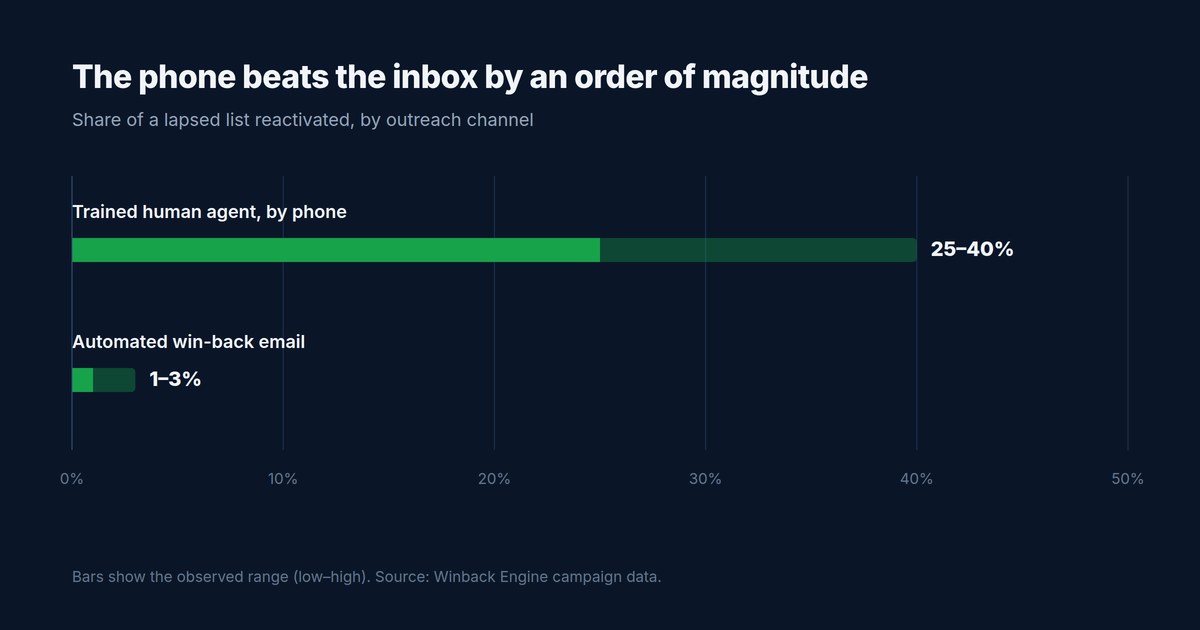
That is not a small edge; it is an order of magnitude, and it is stubbornly consistent — we compare human agents against automated email in detail. Email survives in most plans because it is cheap, long after it has stopped working. Cost per send is the wrong metric; cost per reactivated client is the right one, and on that measure the phone wins comfortably. If you want the actual words, our reactivation call script is the one our agents run.
One compliance note before anyone dials. Under the FTC’s established business relationship exemption, a business may call a customer whose number is on the National Do Not Call Registry for up to 18 months after their last transaction, as long as the customer has not asked it to stop. A recently lapsed list is, by definition, inside that window.
12. Work the list newest-first, at full price
Sort the lapsed list by recency and work it in order — the three-week lapse before the two-year ghost. And skip the reflexive discount: in our experience lapsed clients rebook at full price far more often than operators expect, because the barrier was never price. It was inertia. A 40% win-back offer trains your best clients to wait for the next one and destroys the margin on the visit you just recovered.
Customer Retention by Vertical: Quick Takes
The mechanics above are universal; the lapse windows and failure modes are not.
Fitness. Gym and studio retention is habit retention: a member who has not visited in two weeks is already at risk long before the cancellation request arrives, so usage data — not billing data — is the early-warning system. Contract billing also hides the fade, because revenue continues after attendance stops. Our gym member retention strategies post goes deep on the fitness-specific plays, and the fitness reactivation page covers how we run win-back for gyms and studios.
Med spa. Med spa clients run on treatment cycles — tox every three to four months, filler and series-based treatments on their own cadences — so the recall workflow can be anchored to clinical timing rather than guesswork. The margin profile also makes discounting uniquely destructive; we wrote up how med spas retain clients without discounting, and the med spa page covers the reactivation side.
Dental. Dental has the most institutionalized recall culture of any service vertical and still bleeds patients, because recall postcards and email sequences reach the willing and miss the drifting. Hygiene reactivation is the wedge: a recovered hygiene patient restores a recurring six-month revenue slot plus downstream treatment. See the dental patient reactivation page for how that program runs.
Salon and spa. Salon retention lives and dies on the individual provider relationship and the rebook-at-checkout habit — which makes staff departures the single biggest churn event a salon faces. Spas have a harsher version of the first-visit problem, where a good experience still fails to convert into a second booking; why spa clients never rebook unpacks that pattern, and the salon and spa page covers reactivation for the category.
Common Customer Retention Mistakes
Measuring retention at the brand level. One blended number across locations is how a churn problem hides inside a growth story. Per-location, per-service-line, or it is not measurement.
Counting new clients as retention. Skipping the “minus N” in the formula flatters every report it touches.
Running reactivation as an annual clear-out. Blasting a two-year-old list once a year is the worst version of win-back: you are only ever contacting the coldest names, and you train the list to ignore you.
Discounting as the default win-back lever. Price was rarely the reason the client lapsed. Lead with the relationship and the open slot, not 40% off.
Treating retention as a marketing project. Most of the plays above — checkout scripts, staff-transition protocols, lapse triggers — are operations, not campaigns. If retention lives only in the marketing department, the front desk never changes.
Replacing churn with acquisition. New-client acquisition costs a multiple of what recovering an existing relationship costs — the ROI comparison runs the numbers — and the replacement client arrives on a discount with a 60%+ chance of never returning after visit two. Doing more of that is not a growth strategy. It is a treadmill with a marketing budget attached.
Operator Takeaways
Customer retention in a multi-location service business comes down to a short list done consistently:
- Define it. Retention rate per location, lapse window per service line. Without these, everything else is anecdote.
- Fix checkout first. Rebook-at-checkout is the cheapest retention win available and it starts working the same week.
- Own the first ninety days. The majority of client loss happens at visits one and two; that is where the process investment goes.
- Manufacture the cancellation event. A lapse trigger that puts clients on a call list within a week of crossing the window.
- Call, newest-first, full price. The phone beats email by an order of magnitude in our campaign data, and recency is most of the remaining variance.
- Handle staff departures as churn events. Reassign, introduce, and call the high-LTV clients before they find out the hard way.
Everything else is optional. If you want to know what your own inactive list is worth before deciding where retention ranks on the priority list, run your numbers through the ROI calculator — and if you would rather not build a calling operation from scratch, that is the part we do.